Water Sorter
- 4.2
- Rating
- 1.00M
- Installs
- Free
- Price

 Analysis by App-foxy
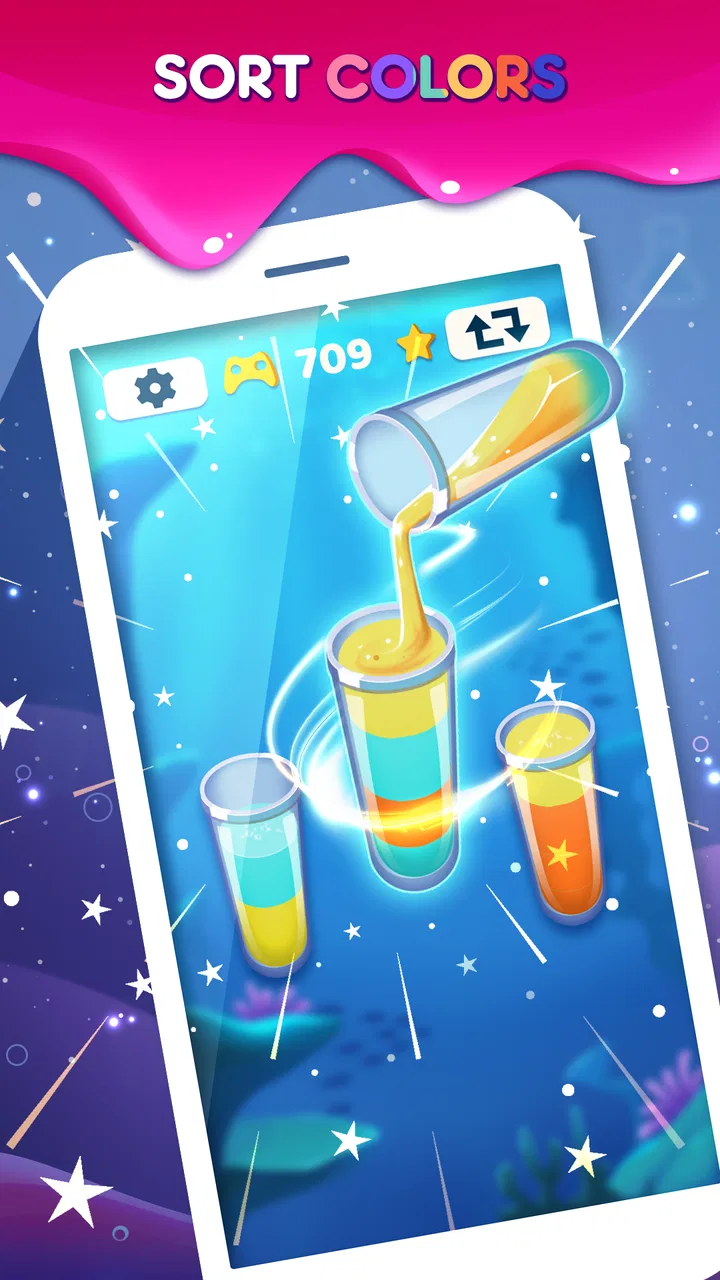
I spent time with Water Sorter as a casual puzzle game, and my first impression was that it understands the appeal of a simple visual challenge. The screen presents a colorful mix that needs to be separated into matching containers, so the basic goal is immediately understandable: move liquid from one container to another until each color is organized. It is the kind of game I can open for a short break without first learning a complicated rule set.
That simplicity is also the main reason it is approachable. Water Sorter is a free puzzle game from Gimica GmbH, rated for Everyone, and it has attracted more than a million installs. Its average rating sits at 4.2 from roughly sixteen thousand ratings, with about 2.9 thousand written reviews. Those figures suggest a broad audience, but they do not remove the need to ask a more useful question: is the game comfortable and understandable for the way you personally play?
How comfortably Water Sorter supports different players
I find that Water Sorter’s straightforward visual layout makes it approachable, but comfort depends on more than understanding the goal. In this section, I look at how color recognition, touch accuracy, and the freedom to think at your own pace can shape the experience for different players. Those practical differences also help explain which everyday situations suit the game best.
You May Also Like

 Blood Strike: 2.5 Anniversary
Blood Strike’s Loadouts Turn Every Drop Into a Tactical Gamble
A close look at Blood Strike’s custom loadouts: how fast access to signature weapons reshapes its battle royale rhythm, rewards preparation, and narrows the gap between fights.

 Pandora - Music & Podcasts
Pandora’s Music Is Easy to Start, but Harder to Recover
Pandora’s strength is its low-effort path from a seed to a station. Its weak spot is how much confidence it asks you to place in connection, setup, and quiet recovery.

 8 Ball Pool
 Is Built on Rivalries, Rematches, and Routine
A close look at the rivalries, rematches, shared routines, and unanswered safety questions that turn a quick pool match into a persistent mobile community.

 Samsung Music
’s Quiet Strength Is Playing What You Already Own
Its reach comes less from spectacle than from dependable access to a personal library. That simplicity is both the app’s strongest retention engine and its ceiling.

 AccuWeather: Weather Radar
AccuWeather Review: A Quick, Clear Forecast for Everyday Decisions
For everyday plans, the best forecast is the one you can understand quickly. AccuWeather makes rain timing, radar, and local conditions easy to act on, with a few trade-offs.

 Hill Climb Racing
Why Hill Climb Racing Still Turns Crashes Into One More Run
A tiny car, a bumpy hill and one more upgrade: Hill Climb Racing keeps resurfacing because its simple chaos makes every near-miss feel personal.
More From Our News Desk



Readability and navigation during a puzzle
The central interaction is easy to grasp because the visual arrangement does most of the explaining. Instead of asking me to remember a long sequence of rules, the game makes the colored layers the focus. I can look at the containers, identify a possible match, and decide whether a pour will open a better move. That direct relationship between what I see and what I do is one of the strongest parts of the experience.
For a new player, the opening moments should feel much less intimidating than a typical logic game with menus, symbols, and several systems competing for attention. The puzzle itself is the navigation. I do not need to move through elaborate screens to understand what the next decision concerns. This makes it suitable for someone who prefers visual learning or who does not want to read a tutorial before playing.
There is a useful difference between recognizing the goal and solving the puzzle, though. The goal is obvious, but the correct order of moves is not always obvious. A container may look like the best destination because its top color matches, yet using it too early can block a later transfer. I found that the game rewards pausing for a moment and scanning all available spaces rather than tapping the first legal-looking option.
My practical advice is to treat empty containers as working space, not merely as places to finish a color. Before making a move, I look for a color that is buried under another layer and ask whether the move will expose it. This small habit makes the game feel less like random tapping and more like planning. It is also helpful for players who need extra time to process a busy visual arrangement.
Navigation is clearest when I focus on one question at a time: which color can move now, and where can it safely go? Trying to track every possible sequence at once can make even a simple board feel crowded. The game benefits from this narrow approach because its challenge comes from ordering decisions, not from a large number of controls.
Visual, motor, and sensory considerations
Color is the main information channel, so visual distinction matters more here than in many other puzzle games. Players who identify colors easily will probably understand the board quickly. Players with color-vision differences may have a harder time when two shades appear similar, especially when the containers are partly filled and the layers are stacked close together. I would not choose this game as a first option for someone who needs every game element to be identified through text, shape, or sound.
The game’s visual simplicity can still be helpful for people who find dense interfaces tiring. There are not many competing objects to interpret inside the puzzle itself, and the task stays focused on the containers. I personally find that less mentally noisy than a match-three game filled with animated effects, timed events, boosters, and several types of collectible objects.
Motor demands are also relatively straightforward. The essential action is selecting a container and directing a pour, rather than performing rapid swipes or repeated precision gestures. That makes it a better fit for a player who prefers deliberate taps over fast reactions. However, deliberate does not mean effortless for everyone. A player with tremors, limited reach, or difficulty making accurate taps may still find selecting a narrow container uncomfortable, particularly when several choices sit close together.
This is where the difference between a puzzle being simple and being physically accessible becomes important. Water Sorter reduces the number of gestures needed to solve a problem, but it does not automatically solve issues involving target size, hand stability, or screen reach. I would test it in a quiet session rather than assume that a low-action game will suit every motor profile.
There is no need to react instantly to a timer in the basic puzzle idea, which makes the game more forgiving for players who want to think before acting. That is a meaningful advantage for me. I can stop, inspect the arrangement, and choose a move based on its consequences. It works well during a short mental reset because the pressure comes from reasoning rather than speed.
At the same time, the strong reliance on color means the game is not equally informative through every sense. Someone who benefits from audio cues or tactile feedback should not expect the visual sorting task to be translated into a different form. The experience is built around seeing the mix and seeing it become organized.
Playing in ordinary situations
Water Sorter fits naturally into small gaps in the day. I can imagine playing it while waiting for an appointment, taking a short break from work, or sitting on public transport. A single puzzle can be approached as a contained task rather than a commitment to a long session. That is useful for people whose attention comes in short windows or who prefer games that can be put down without losing the thread of a larger story.
It is less suitable when my surroundings are distracting. Although the controls are uncomplicated, solving a board requires enough concentration to remember which containers have become useful and which have become blocked. In a noisy room, I may still be able to make moves, but I am more likely to overlook a better sequence and create unnecessary backtracking.
The visual format also makes screen conditions important. Bright outdoor light, glare, or a dim display can make similar colors harder to separate. I would adjust the phone’s brightness and angle before blaming myself for a difficult board. This is a small but realistic consideration: a puzzle based on layered colors depends heavily on seeing those layers clearly.
For a shared setting, the game can work as a quiet, low-pressure activity, but it is not automatically a cooperative experience. I would recommend it to someone who wants an individual puzzle rather than a game built around conversation or teamwork. A parent might also find the Everyone rating reassuring for general family use, while still checking whether the child can distinguish the colors comfortably and handle the tapping independently.
It can also suit players who want to practice planning without the complexity of traditional board games. The useful skill is not memorizing a large rulebook; it is noticing how one move changes the available space. I would use it as a gentle way to exercise sequencing and forward thinking, not as a formal learning tool or a substitute for a structured accessibility program.
What makes the puzzle more thoughtful than it first appears
The most important strategic insight is that a correct move is not always a good move. If I pour a visible color into the only container where it fits, I may gain immediate progress but lose the empty space needed to uncover another color. The best decisions often preserve flexibility. I try to keep at least one useful destination available instead of filling every possible space as soon as I can.
A second useful approach is to distinguish between exposing a color and completing a color. These are not the same objective. Moving a top layer away may reveal the color I need, even if the receiving container is not its final home. Thinking in terms of access rather than completion helps prevent the common mistake of chasing a tidy-looking move that makes the rest of the board harder.
I also recommend slowing down when two containers appear to offer equally good destinations. One may create a longer uninterrupted stack, while the other may split future options. I compare what will be visible after the pour, not just what the containers look like before it. This is the kind of small tactical habit that gives the game more depth than the short description suggests.
Another trade-off is the value of restarting a difficult position. If I have used the available space poorly, continuing can become a series of forced repairs rather than a satisfying solution. Starting over may feel like losing progress, but it can be the more relaxed choice when the board is already compromised. Players who dislike repetition may find this frustrating; players who enjoy refining a plan may appreciate it.
The game’s appeal therefore depends on the type of puzzle satisfaction I want. It is not primarily about discovering a hidden story, collecting a large set of tools, or competing through fast reactions. Its pleasure comes from gradually turning a tangled arrangement into a clean one. That narrow focus is a strength for some players and a limitation for others.
Where the experience may create friction
The biggest barrier is the dependence on color recognition. Even when the board is visually uncluttered, similar shades can slow down identification. A player may understand the rules perfectly and still struggle because the important distinction is difficult to perceive. I would skip this game, or at least try it before committing to regular play, if color-based interfaces routinely cause fatigue or uncertainty.
The second barrier is the need for accurate selection. The game does not ask for complex gestures, but a misplaced tap can send a layer somewhere I did not intend. That can be especially annoying when I am playing one-handed, holding the phone at an awkward angle, or using a smaller screen. The experience is calmer than an action game, yet it still depends on reliable touch control.
There is also a mental-access barrier for players who find open-ended planning tiring. The rules are simple, but the number of possible sequences can grow as the board becomes more mixed. Someone looking for a completely effortless distraction may prefer a matching game with obvious immediate moves. Water Sorter asks me to hold a few future consequences in mind, even when the interface itself remains uncomplicated.
The game is free to play, with in-app purchases ranging from $0.99 to $3.49 per item. That makes trying it low-risk, but anyone managing spending should remember that optional purchases are part of the experience. I would decide in advance whether I want to play without buying anything, especially if I am prone to using purchases to bypass frustration. A free entry point is useful, but it does not automatically mean the whole experience is free of commercial pressure.
Device compatibility is another practical point. The listed minimum operating system is Android 7.0, while the current version is 1.32.0. For someone using an older phone, checking compatibility before installing is sensible. This matters particularly for family devices, backup phones, or phones kept for simple tasks, where the operating system may not be current.
The game was released on June 29, 2023, and its continued presence alongside a large install base makes it easy to regard as an established casual option. Still, popularity is not a substitute for personal fit. I would judge it by how comfortably I can distinguish the colors, select containers, and tolerate the planning style rather than by the size of its audience.
How it compares with familiar puzzle alternatives
Compared with match-three games, Water Sorter is quieter and more deliberate. Match-three play usually rewards scanning for immediate combinations, while this game asks me to protect space and plan a sequence. If I want bright action, frequent effects, and quick feedback, a match-three alternative may be more engaging. If I want a board that rewards patience and does not depend on rapid choices, Water Sorter is the better fit.
Compared with word puzzles, it removes language from the central challenge. That can be helpful for someone who does not want vocabulary or spelling to determine success. On the other hand, word games may be more comfortable for a player who finds color differences difficult or who prefers information represented through letters and meanings.
Compared with number-based logic games, the sorting format feels more concrete. I can see the layers and the available space rather than working mainly with symbols or calculations. This may make the first step easier, although the later planning can still be demanding. A number puzzle is likely preferable for someone who wants explicit numerical relationships; this one is preferable for someone who enjoys visual organization.
Compared with fast arcade puzzles, it is much more accommodating of a slower pace. There is no reason for me to rush a decision simply to keep up with a timer-driven rhythm. That makes it a sensible choice for relaxed play, but it can feel too restrained for someone who needs constant stimulation. The absence of speed pressure is either a welcome relief or a lack of excitement, depending on what I am seeking.
Who I would recommend it to
I would recommend Water Sorter to a player who likes tidy visual problems, prefers short sessions, and enjoys improving a plan after noticing a mistake. It is especially appealing if you want a puzzle that can be understood quickly but still rewards careful sequencing. The Everyone rating also makes it a reasonable candidate for general family use, provided the individual player is comfortable with color-based information and touch controls.
I would be more cautious recommending it to someone who needs strong non-color alternatives, who has difficulty with small touch targets, or who wants a game with a story, social interaction, or constant novelty. I would also point a highly competitive player toward a puzzle with clearer scoring pressure or head-to-head play. Water Sorter is about the satisfaction of solving the arrangement, not about proving speed or building a public profile.
For my own use, the best scenario is a short pause when I want something more engaging than scrolling but less demanding than a full game session. I can examine the containers, make a plan, and stop after a puzzle without feeling that I have abandoned a complicated campaign. That focused scale is the reason I keep coming back to this type of game.
My inclusive verdict
Water Sorter succeeds because its core idea is immediately visible and its controls stay close to the puzzle itself. I like that it gives me room to think, rewards preserving empty space, and works well in brief everyday sessions. Its visual organization can feel calming, and its limited interaction style is friendlier to slow, deliberate play than many action-oriented alternatives.
Its inclusiveness has clear limits. Color does most of the communication, touch accuracy still matters, and the planning can become mentally tiring for players who want a purely effortless distraction. The free price makes experimentation easy, while the listed optional purchases are worth keeping in mind for anyone who wants strict control over spending.
My final view is positive but specific: Water Sorter is a good choice when visual sorting and patient planning are comfortable for you. I would try it for a few puzzles under normal lighting and with the hand position I usually use. If the colors are easy to separate and the taps feel manageable, it offers a clean, satisfying puzzle loop. If those two basics already create strain, a word, number, or audio-supported alternative would likely serve you better.
FAQs for Water Sorter
01What is Water Sorter and how do you play it?
Water Sorter is a color-sorting puzzle game in which you pour layers of colored liquid between bottles until every bottle contains only one color. You can usually pour liquid only when the destination bottle is empty or has the same color on top, and it has enough available space. The controls are simple, but planning several moves ahead becomes essential as levels get harder.
02Is Water Sorter free to download and play?
Water Sorter can generally be downloaded and played for free, making it easy to try without an upfront purchase. However, the game may include advertisements, optional in-app purchases, or both, depending on the version and platform. Ads can appear between levels or after requesting assistance, so users who prefer uninterrupted play should check the store listing for the exact monetization details.
03Does Water Sorter work offline?
Many parts of Water Sorter can be played without an internet connection, which is convenient for traveling, commuting, or playing in areas with limited coverage. Basic puzzle progress is typically available offline, but advertisements, cloud synchronization, updates, leaderboards, or certain promotional features may require internet access. Availability can vary between versions, so test offline play after installation.
04Is Water Sorter suitable for children and casual players?
Water Sorter is suitable for most casual players because it uses straightforward tap controls, clear visual rules, and short levels that can be completed at the player’s own pace. It does not require fast reflexes, although later puzzles demand concentration and logical thinking. Parents should still review advertising, purchase options, and privacy settings before allowing younger children to play.
05What should I do if I become stuck on a Water Sorter level?
If a level becomes difficult, avoid pouring randomly because an incorrect move can reduce your available space and make the puzzle harder to recover. Try exposing hidden colors gradually, keep at least one bottle available for temporary storage, and consider undo or restart options if they are provided. Some versions also offer hints, but these may be limited or connected to watching an advertisement.
Pros
- Simple one-finger controls make it easy to start playing immediately.
- Short levels are convenient for quick breaks or casual sessions.
- Colorful liquid animations make the sorting process visually satisfying.
- Increasing difficulty provides a gradual challenge for puzzle fans.
- Offline play is useful when you have no internet connection.
Cons
- Later puzzles can feel repetitive once the sorting pattern becomes familiar.
- Mistakes may require restarting a level instead of offering many recovery options.
- Some stages depend more on trial and error than careful planning.
- Ads can interrupt the experience
- especially between completed levels.
- The minimalist presentation may feel too basic for players seeking variety.

Water Sorter
Gallery